
What Is tDCS? Transcranial Direct Current Stimulation Explained
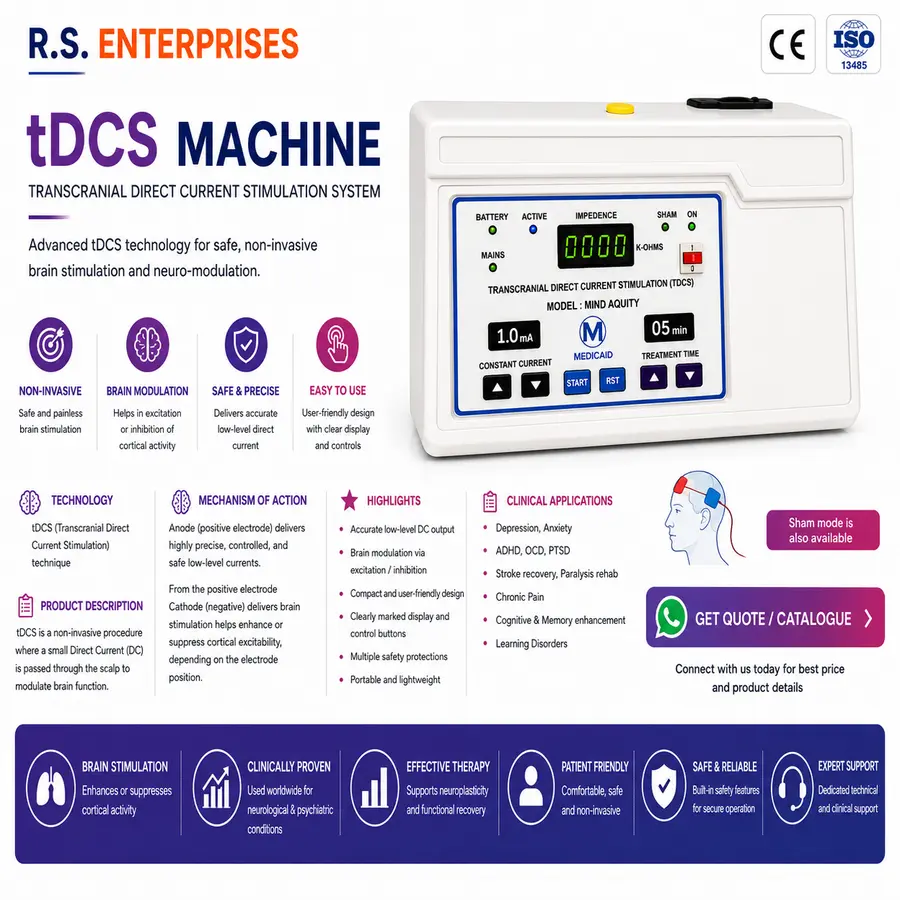
Transcranial direct current stimulation (tDCS) is a simple, portable form of non-invasive brain stimulation. It does not trigger neurons to fire directly. It gently shifts how readily they fire.
How tDCS works
Two electrodes, an anode and a cathode, are placed on the scalp, and a weak constant current flows between them.
- Anodal stimulation generally makes the cortex underneath more excitable.
- Cathodal stimulation generally makes it less excitable.
The effects can outlast the session and, with repeated sessions, may support longer-term change.
A typical session
- Current: 1–2 mA (the MA-tDCS offers 0.5–4 mA).
- Duration: 20–30 minutes.
- Electrodes: saline-soaked sponges (25–35 cm²) or HD electrodes.
- Ramp: current ramps up and down over a few seconds.
Uses under study and in practice
- Depression. Commonly anodal left DLPFC.
- Stroke rehabilitation. Motor and language recovery.
- Chronic pain.
- Cognition and research. Memory, attention and learning.
- Addiction and craving. Research applications.
Advantages
- Portable and low cost.
- Easy to combine with therapy or training tasks.
- SHAM mode allows rigorous blinded research.
Safety
Within standard parameters, tDCS is well tolerated. Common sensations are tingling, itching or redness under the electrodes. Avoid broken skin, check impedance and follow published guidelines. See tDCS safety and SHAM.
Equipment
The MA-tDCS includes a TFT touchscreen, ramp control, impedance monitoring, auto shut-off and SHAM mode in a 200–300 g unit.
Compare tDCS with rTMS in our tDCS vs rTMS guide.
tDCS Machine
Touchscreen tDCS with SHAM mode, 0.5–4 mA and impedance monitoring. ₹75,000 – ₹80,000
Frequently Asked Questions
Does tDCS cause seizures?
tDCS at standard parameters has not been associated with seizures in the research literature.
How does tDCS feel?
Mild tingling or itching under the electrodes, especially at the start.
How many sessions are needed?
Protocols commonly use daily sessions over one or more weeks.
This article is for general information for healthcare buyers and professionals and is not medical advice. Clinical decisions should be made by qualified practitioners.


