
tDCS in Stroke Rehabilitation: Motor and Language Recovery
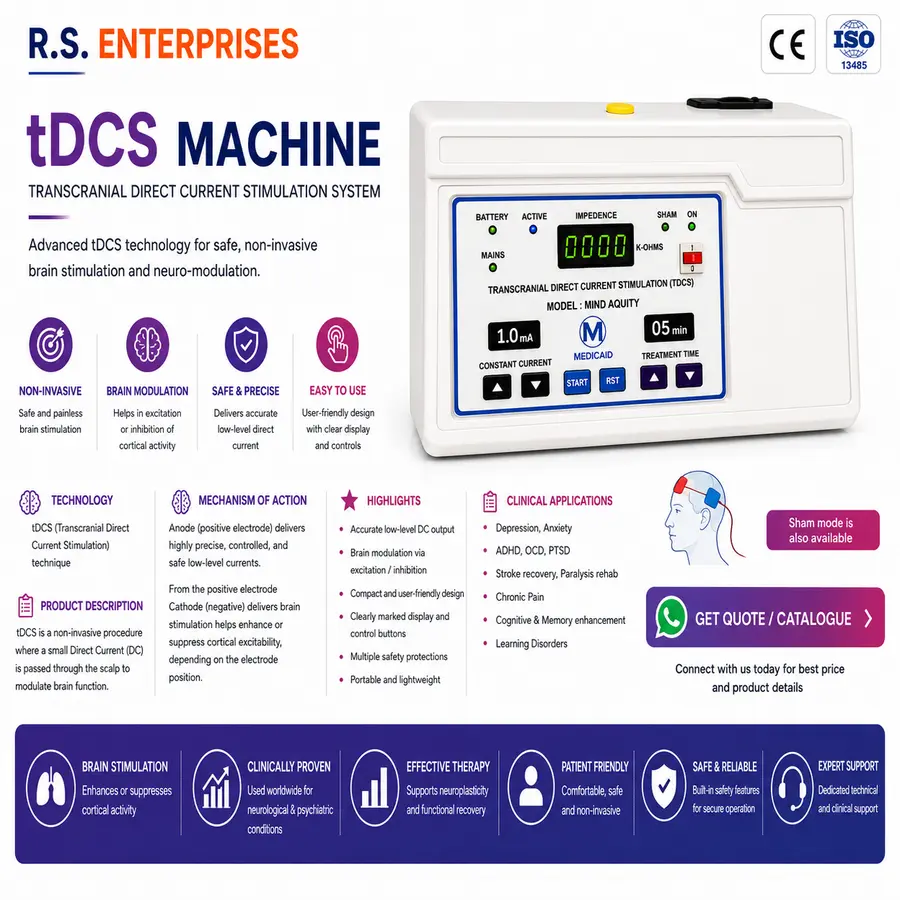
Stroke rehabilitation relies on neuroplasticity, the brain’s ability to reorganise. tDCS is a low-cost tool studied for its potential to support that process.
Why tDCS fits rehab
- Portable and quiet, so it can run during therapy sessions.
- Inexpensive compared with other neuromodulation.
- Well tolerated.
Common approaches
| Approach | Montage idea | Goal |
|---|---|---|
| Anodal ipsilesional | Anode over affected motor cortex | Increase excitability |
| Cathodal contralesional | Cathode over unaffected motor cortex | Reduce over-inhibition |
| Bilateral | Anode affected, cathode unaffected | Both |
| Language | Anode over left language areas (protocol dependent) | Support aphasia therapy |
Pairing with therapy
Combine tDCS with:
- Task-specific upper-limb training.
- Constraint-induced movement therapy.
- Speech and language therapy.
- Gait training.
Evidence status
Research shows promising but variable effects. Results depend on stroke type, timing, montage and the therapy it is paired with. Rehab centres should track outcomes with standard measures such as the Fugl-Meyer assessment or aphasia scales.
Practical tips
- Standardise montages with careful measurement. See tDCS montages.
- Inspect the skin each session, as sensation may be reduced after stroke.
- Document every session.
Equipment
The MA-tDCS is portable (200–300 g), runs on battery or AC and has a touchscreen with logs and impedance monitoring. For focal stimulation, see rTMS in stroke rehabilitation.
Contact us to equip your rehab centre.
tDCS Machine
Touchscreen tDCS with SHAM mode, 0.5–4 mA and impedance monitoring. ₹75,000 – ₹80,000
Frequently Asked Questions
When should tDCS be applied — before or during therapy?
Many protocols apply tDCS during or just before task practice; follow the protocol in use.
How many sessions?
Studies often use daily sessions over 1–4 weeks alongside therapy.
Is tDCS a replacement for physiotherapy?
No — it is an adjunct to rehabilitation.
This article is for general information for healthcare buyers and professionals and is not medical advice. Clinical decisions should be made by qualified practitioners.


