Uroflowmetry Test Guide: Procedure, Parameters and Equipment
Uroflowmetry is one of the simplest urology tests and among the most useful. The patient voids into a device that measures flow over time.
Parameters measured
- Qmax: maximum flow rate (mL/s).
- Qavg: average flow rate.
- Voided volume.
- Voiding time and flow time.
- Time to Qmax.
- Flow curve shape.
Common indications
- Lower urinary tract symptoms (LUTS) in men, such as suspected BPH.
- Pre- and post-TURP assessment.
- Suspected urethral stricture.
- Paediatric voiding dysfunction.
- Follow-up after treatment.
Test preparation
- Arrive with a comfortably full bladder.
- Void normally in private.
- A voided volume of at least about 150 mL gives more reliable results.
- Post-void residual is often checked by ultrasound.
Reading flow curves
- Bell-shaped: normal.
- Flattened, prolonged: suggests obstruction (e.g., BPH, stricture).
- Intermittent: straining or dysfunctional voiding.
Always interpret together with symptoms and other tests.
Equipment
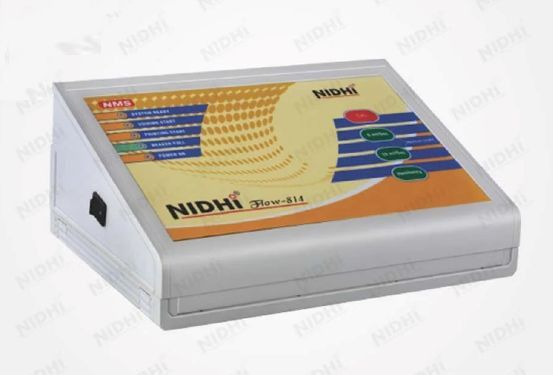
The NidhiFlow 814 digital uroflowmeter uses a weight-based piezoresistive transducer:
- 2000 mL capacity, 50 mL/s peak flow.
- ±5% voided volume accuracy.
- Auto-start, auto-print and beaker-full alarm.
- On-site auto-calibration.
- Price: ₹0.9–1.10 lakh.
Request a quote for your urology department.
Digital Uroflowmetry Machine
Weight-based digital uroflowmeter with printer and auto-start. ₹90,000 – ₹1.1 lakh
Frequently Asked Questions
How much urine is needed for a reliable test?
A voided volume of at least around 150 mL is commonly recommended for reliable interpretation.
Is the test private?
Yes — patients void privately into the device.
What does a low Qmax suggest?
Possible obstruction or weak bladder contraction; further evaluation may be needed.
This article is for general information for healthcare buyers and professionals and is not medical advice. Clinical decisions should be made by qualified practitioners.