
ECG Artifacts and Troubleshooting: Fix Noisy Tracings Fast
A noisy ECG wastes time and can mislead. Most problems are quick to fix once you know the cause.
Troubleshooting table
| Artifact | Looks like | Common causes | Fix |
|---|---|---|---|
| AC interference | Thick, fuzzy baseline | Nearby equipment, poor earthing, cables near power cords | Move cables, unplug nearby devices, check earthing, then the AC filter |
| Muscle tremor | Irregular fine spikes | Cold, anxious, talking or shivering patient | Warm room, reassurance, arms supported |
| Baseline wander | Slow drifting baseline | Breathing, movement, poor contact, sweat | Skin prep, fresh electrodes, steady breathing |
| Loose electrode | Flat line or sudden spikes in one lead | Dry gel, poor adhesion | Replace electrode |
| Lead reversal | Unexpected axis, inverted lead I | Wrong limb cable placement | Check RA/LA/LL/RL positions |
| Pacemaker spikes | Sharp vertical lines | Paced rhythm (not an artifact) | Enable pacemaker detection |
Prevention checklist
- Prepare the skin properly.
- Use fresh, in-date electrodes.
- Keep the patient warm, relaxed and still.
- Route cables away from power cords.
- Use the machine on battery if mains interference persists.
- Check calibration and settings (25 mm/s, 10 mm/mV).
Filters: use wisely
Filters reduce noise but can distort waveforms, especially ST segments. Fix the source first.
Equipment features
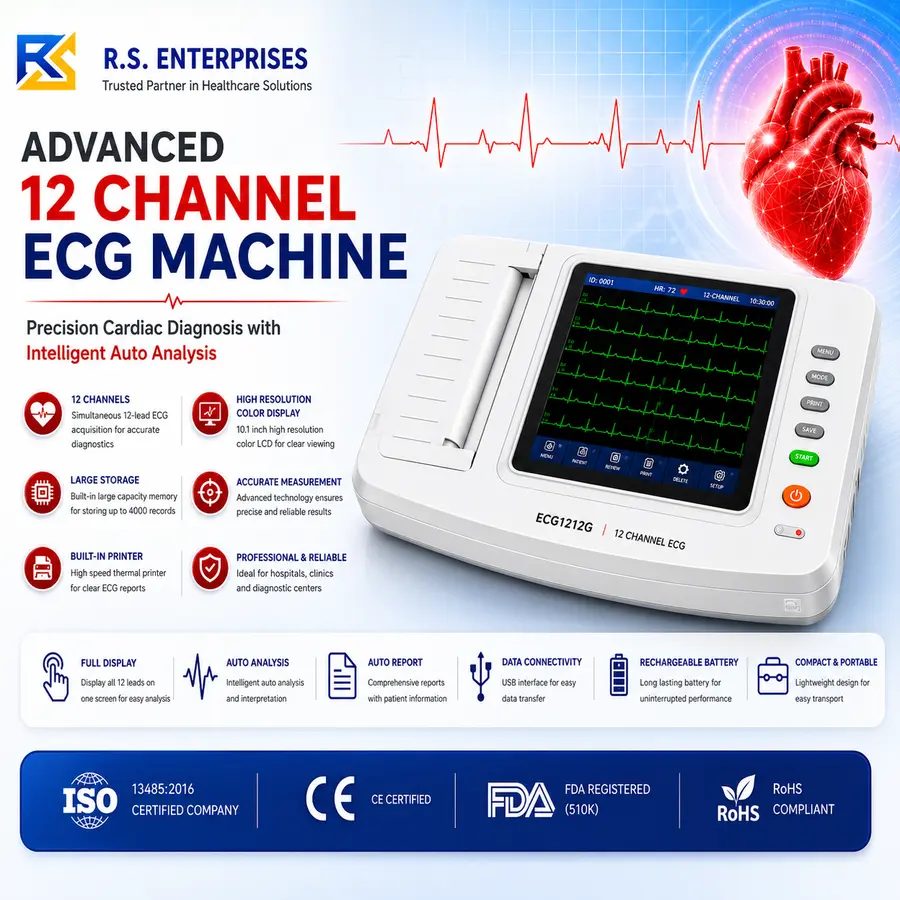
High CMRR (105 dB on the Maestros 12 Channel), lead-off detection and battery operation help produce clean tracings.
Related: ECG electrode placement.
12 Channel ECG Machine
12 channel interpretive ECG with 5" touch display and A4 printer. ₹60,000 – ₹1 lakh
Frequently Asked Questions
What causes a wandering baseline?
Breathing, movement, poor electrode contact or sweat.
What does 50 Hz interference look like?
A thick, fuzzy baseline with regular fine oscillations.
Can artifacts mimic arrhythmias?
Yes — tremor and movement can mimic atrial flutter or VT.
This article is for general information for healthcare buyers and professionals and is not medical advice. Clinical decisions should be made by qualified practitioners.