Video EEG vs Routine EEG: Differences and When You Need Each
Both tests record brain waves, but they answer different clinical questions. Understanding the difference helps hospitals decide which service to build first.
Routine EEG
A routine EEG lasts 20–40 minutes and includes activation procedures such as hyperventilation and photic stimulation. It is quick, inexpensive and widely available. The limitation is time: many patients with epilepsy have normal EEGs between seizures, so a short recording may miss abnormalities.
Video EEG
Video EEG records the EEG continuously with synchronised video, often for hours or days. When an event happens, the clinician can see exactly what the patient did (stiffening, staring, jerking or talking) and compare it with the EEG at that moment.
When video EEG is ordered
- To distinguish epileptic seizures from non-epileptic events such as syncope or psychogenic non-epileptic seizures.
- To classify seizure types correctly for treatment.
- To localise seizure onset in drug-resistant epilepsy before surgery.
- To quantify seizure frequency, especially in children.
- To monitor ICU patients for non-convulsive seizures.
Equipment differences
| Item | Routine EEG | Video EEG |
|---|---|---|
| Amplifier | 19–24+ channels | 32–64 channels typical |
| Camera | Not needed | HD camera with night vision |
| Software | Acquisition and review | Synchronised video and EEG, event detection |
| Storage | Modest | Large (video files) |
| Room | Quiet lab | Monitoring room with bed and safety padding |
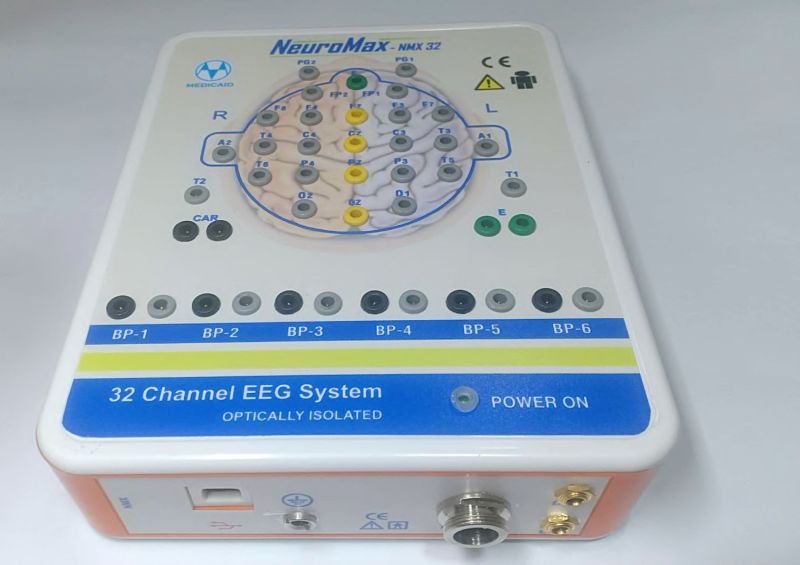
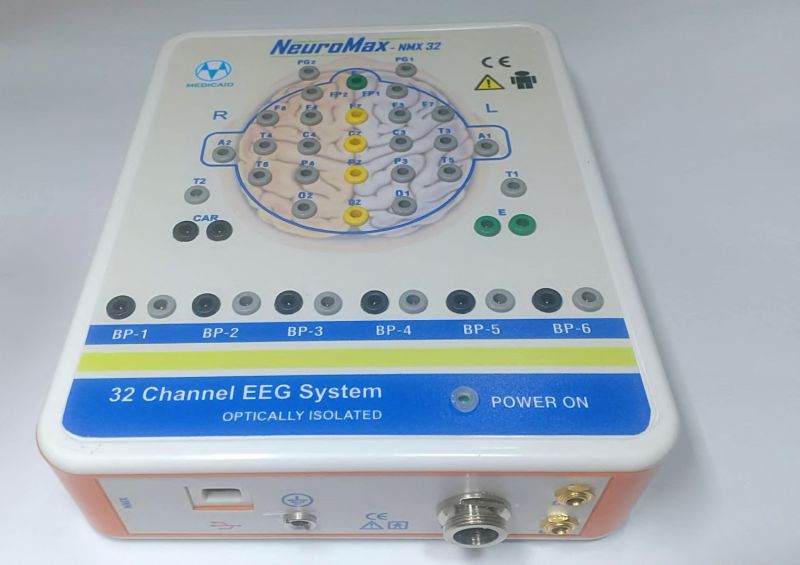
Systems like the NEUROMAX 32 channel video EEG and 64 channel NMX-64 include dual-monitor support and night-vision cameras for overnight monitoring.
Cost considerations
Video EEG systems cost more than routine EEG. A 32 channel video EEG is about ₹1.68 lakh incl. GST and a 64 channel video EEG about ₹4.20 lakh, against about ₹1.12 lakh for a 24 channel routine EEG. Budget also for storage, staff time for long recordings and patient safety measures.
Which should you start with?
Most hospitals start with routine EEG and add video when they see enough epilepsy patients. If you plan to grow, choose an amplifier that supports video later. See our comparison of 24 vs 32 vs 64 channel EEG or contact us to plan your EEG service.
32 Channel Video EEG Machine
32 channel digital video EEG for epilepsy centres and long-term monitoring. ₹1.55 lakh – ₹1.75 lakh
Frequently Asked Questions
Is video EEG painful?
No. It is the same scalp recording plus a camera.
How long is a video EEG?
From a few hours to several days, depending on how often events occur.
Can a 24 channel EEG be used for video EEG?
Some systems support video, but 32 channel video-capable systems are more common in EMUs.
This article is for general information for healthcare buyers and professionals and is not medical advice. Clinical decisions should be made by qualified practitioners.