CDSCO and Medical Device Rules: What Hospital Buyers Should Check
Regulation of medical devices in India has tightened considerably in recent years. Hospital purchase teams should understand the basics so they can verify suppliers.
The framework
- The Medical Devices Rules, 2017 came into force in 2018.
- The Central Drugs Standard Control Organisation (CDSCO) oversees regulation, together with state authorities for some classes.
- Devices are grouped into risk classes A (low) to D (high).
- Licensing has been extended in phases so that it covers devices across risk classes.
This is a simplified overview. Check current notifications for exact requirements.
What buyers should request
- Regulatory status: the applicable import or manufacturing licence or registration for the device.
- CE marking or other international certificates, where applicable.
- The supplier’s authorisation from the manufacturer.
- ISO certificates (supplier and/or manufacturer).
- The warranty and service commitment in writing.
- Calibration certificates where relevant.
Red flags
- No authorisation letter from the manufacturer.
- Vague or missing regulatory information.
- No local service capability.
- Prices far below the market without an explanation.
Our compliance
RS Enterprises is ISO 9001:2015 certified, MSME, GST and GeM registered, IEC registered for exports and an authorised Medicaid Systems dealer. Devices in our range are CE marked, and many are CDSCO approved or registered (for example, the MA-tDCS and student physiograph). View our certificates.
Contact us for product-specific documentation.
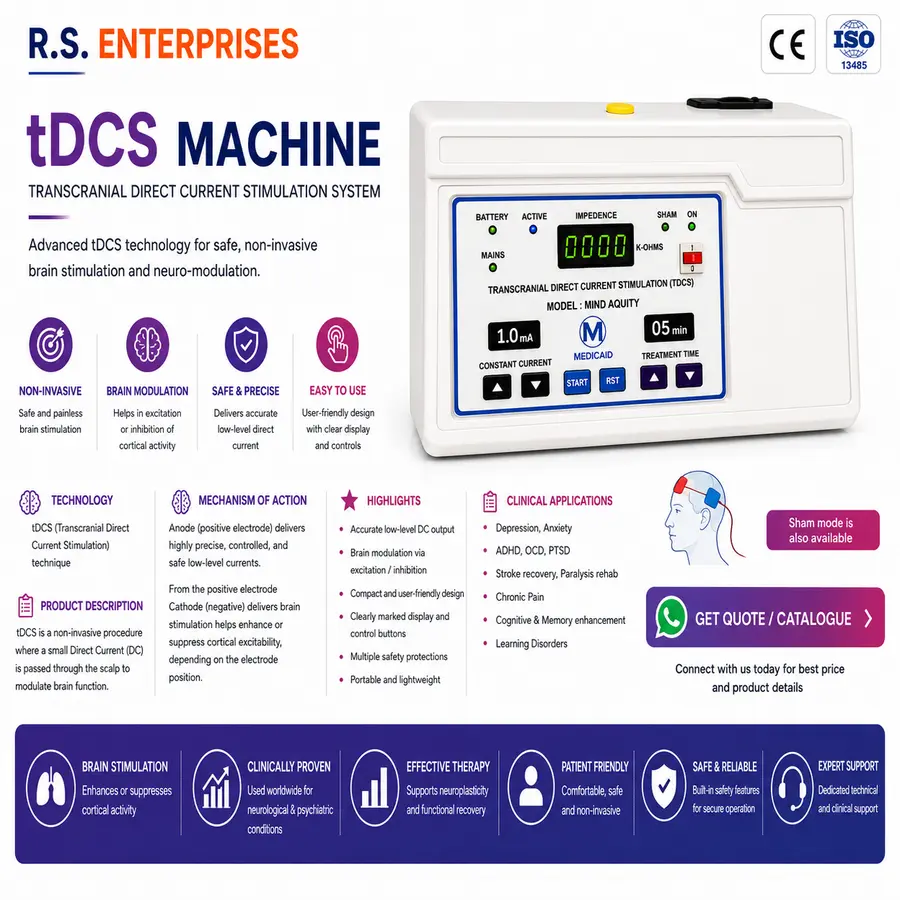
tDCS Machine
Touchscreen tDCS with SHAM mode, 0.5–4 mA and impedance monitoring. ₹75,000 – ₹80,000
Frequently Asked Questions
Does CE marking replace CDSCO requirements?
No — CE is a European conformity mark; Indian regulatory requirements apply separately.
What is risk class?
A classification (A low to D high) that determines regulatory requirements.
What should I ask a supplier for?
Applicable licence/registration details, OEM authorisation, certificates and warranty terms.
This article is for general information for healthcare buyers and professionals and is not medical advice. Clinical decisions should be made by qualified practitioners.