
GSR Biofeedback for Anxiety and Stress: How It Works
When we are stressed, sweat glands activate and skin conductance rises, often before we notice anything. Galvanic skin response (GSR) biofeedback uses this signal to teach calm.
What GSR measures
Electrodermal activity (EDA), or GSR, reflects sweat-gland activity controlled by the sympathetic nervous system. Higher arousal means higher conductance, which is lower resistance.
How a GSR session works
- Sensors are placed on two fingers.
- A baseline is recorded at rest.
- The therapist introduces a mild stressor, such as a mental arithmetic task, to show the response.
- The patient practises relaxation (slow breathing, progressive muscle relaxation, imagery) while watching the GSR fall.
- Visual and audio feedback rewards reductions in arousal.
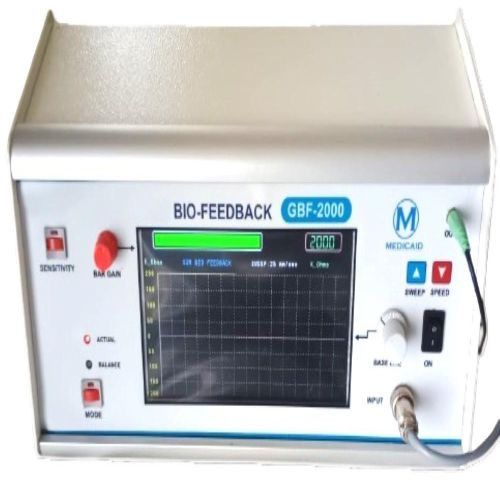
The GBF-2000 GSR module displays values in kΩ, with Actual and Balance modes and a green/red bar indicator.
Program structure
- Weekly in-clinic sessions over several weeks.
- Home practice of the techniques.
- Gradual reduction of the patient’s reliance on feedback.
Who benefits
- Generalised anxiety and stress.
- Exam and performance anxiety.
- Panic disorder (with respiration training).
- Psychosomatic complaints.
Combining modalities
GSR pairs well with respiration and pulse biofeedback. The PC-based CBF-206 records GSR together with EEG, EMG, pulse, respiration and ECG.
Getting started
GSR is an affordable first module at ₹80,000 including GST. See the biofeedback price guide.
Digital Biofeedback Machine
Portable single-parameter biofeedback units — GSR, EEG, EMG, pulse, respiration, ECG. ₹75,000 – ₹86,000
Frequently Asked Questions
Where are GSR sensors placed?
Usually on two fingers of one hand.
Does GSR measure emotions?
It reflects arousal, not specific emotions.
Can GSR be combined with other signals?
Yes — PC-based systems combine GSR with respiration, pulse, EMG and EEG.
This article is for general information for healthcare buyers and professionals and is not medical advice. Clinical decisions should be made by qualified practitioners.


