Evoked Potentials Explained: VEP, BAER and SSEP
Evoked potentials (EPs) measure how quickly and reliably a sensory signal travels from the periphery to the brain. They are objective and non-invasive, and they can be recorded on a standard EMG/EP system.
How EPs work
A stimulus (light, sound or electrical) is repeated many times. The system averages the brain’s responses, which cancels random background EEG and leaves a consistent waveform with recognisable peaks. Clinicians measure peak latencies and amplitudes.
Visual evoked potential (VEP)
- Stimulus: a pattern-reversal checkerboard or LED goggles (flash VEP).
- Key peak: P100.
- Uses: optic neuritis, multiple sclerosis, compressive optic lesions, and assessing patients who cannot communicate.
Brainstem auditory evoked response (BAER/AEP)
- Stimulus: clicks through headphones.
- Key peaks: waves I–V, reflecting the auditory nerve and brainstem.
- Uses: infant hearing screening, acoustic neuroma screening, brainstem lesions and intraoperative monitoring.
Somatosensory evoked potential (SSEP)
- Stimulus: electrical stimulation of the median or tibial nerve.
- Recording: peripheral, spinal and cortical sites.
- Uses: spinal cord lesions, demyelination, coma prognosis and intraoperative monitoring.
Cognitive potentials
P300 and late responses are used in cognitive assessment and research.
Equipment needed
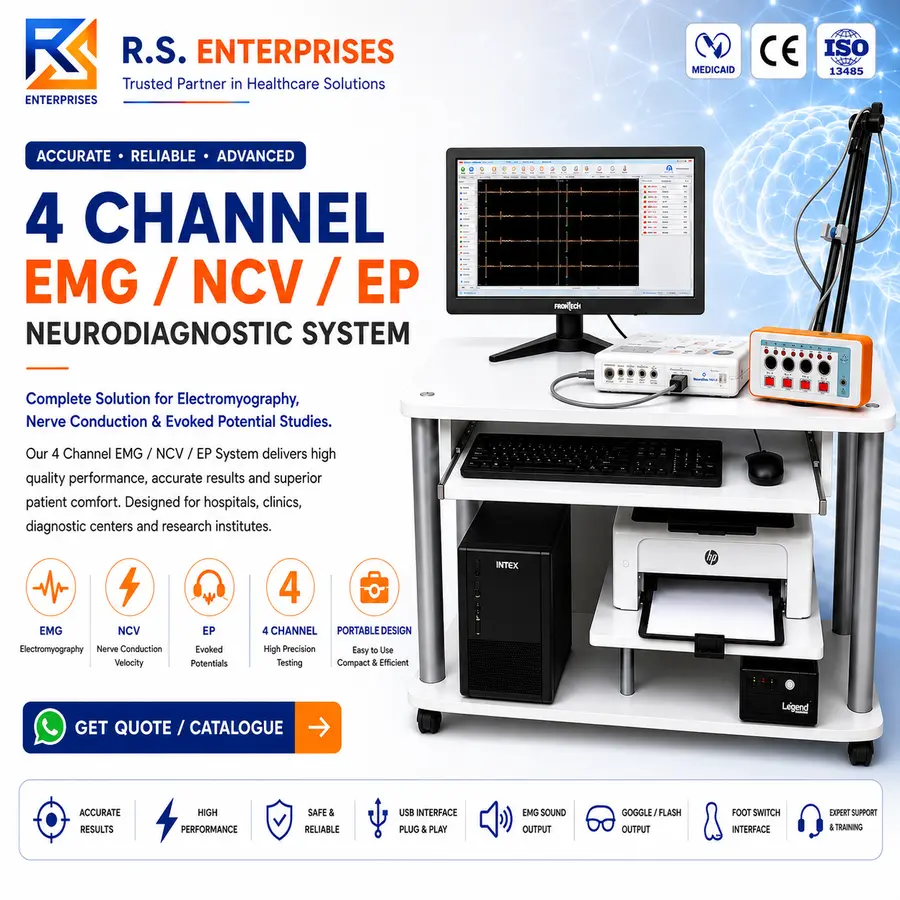
- An EMG/EP system with averaging software such as the NEUROSTIM range.
- LED goggles or a pattern monitor for VEP.
- Headphones for BAER.
- A peripheral stimulator for SSEP.
- More channels (4 or more) make SSEP easier. See 2 vs 4 channel EMG.
Tips for good recordings
- Relaxed, comfortable patient.
- Low electrode impedance.
- Correct stimulus parameters and enough averages.
- Replicate each trial to confirm the waveform.
RS Enterprises supplies complete EMG/EP systems with application training. Request a demo.
EMG / NCV / EP Machine (4 Channel)
Dual channel EMG/NCV/EP upgradeable to 4 channels. ₹2 lakh – ₹3 lakh
Frequently Asked Questions
Why is averaging needed?
EP signals are tiny; averaging hundreds of responses cancels background noise.
Is BAER useful in infants?
Yes, it is widely used for hearing assessment where behavioural tests are not possible.
What is P100?
The main positive peak of the pattern-reversal VEP, normally around 100 ms.
This article is for general information for healthcare buyers and professionals and is not medical advice. Clinical decisions should be made by qualified practitioners.