Common EEG Artifacts and How to Reduce Them
An artifact is any signal in the EEG that does not come from the brain. Some are obvious; others closely resemble epileptiform activity. Recognising and preventing artifacts is a core skill for EEG technicians.
Physiological artifacts
Eye blinks and movements. The eye acts like an electrical dipole, so blinks show as large, slow deflections in the frontopolar electrodes (Fp1, Fp2). Lateral eye movements produce opposite deflections at F7 and F8. Adding EOG channels helps identify them.
Muscle (EMG). Fast, spiky activity from jaw clenching, frowning or neck tension, often over temporal regions. Ask the patient to relax the jaw and keep the room comfortable.
ECG. Regular sharp waves that line up with the heartbeat, common in short-necked or obese patients. Record an ECG channel for comparison.
Sweat. Very slow drifts caused by perspiration changing skin impedance. Keep the room cool.
Movement and tremor. Rhythmic or irregular patterns caused by head or body movement.
Technical artifacts
Electrode pop. A sudden, steep spike limited to one electrode, caused by poor contact or drying paste. Re-prepare that electrode.
50 Hz mains interference. Thick, fuzzy traces. Check earthing, keep cables away from power cords, switch off nearby devices and keep impedances low and balanced.
Cable movement. Swaying leads cause irregular signals. Bundle and secure cables.
Gel bridging. Two neighbouring electrodes show identical signals. Clean the scalp between them and re-apply.
Prevention checklist
- Prepare the skin properly and keep impedances below about 5 kΩ and balanced.
- Use a well-earthed power supply; an online UPS helps.
- Keep the room quiet, cool and comfortable.
- Record ECG and EOG channels.
- Annotate every event (blink, swallow, movement, nurse entry).
- Recheck impedances during long recordings.
Equipment features that help
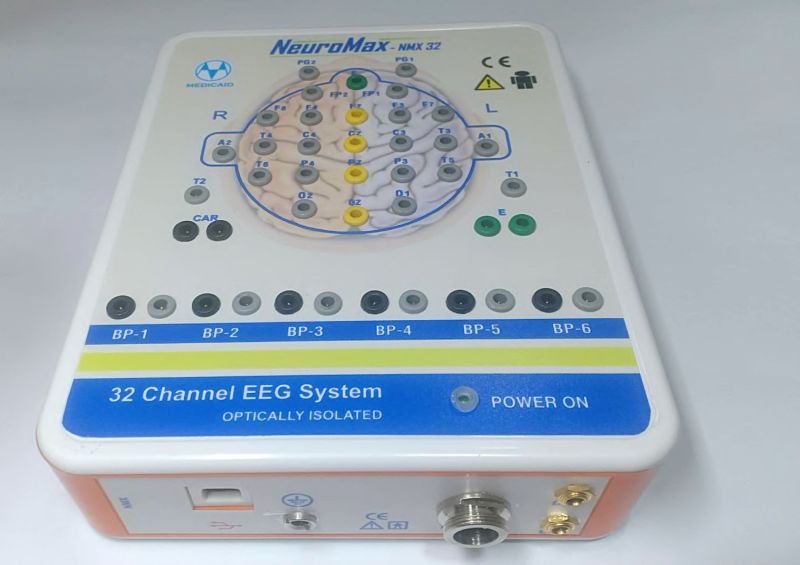
A good amplifier with high input impedance, CMRR above 100 dB and real-time impedance monitoring makes a real difference. Systems like the NEUROMAX NMX-32 and NMX-64 are designed with this in mind.
For more on technique, read our 10-20 placement guide.
32 Channel EEG Machine
Portable 32 channel EEG with video option, expandable to 64 channels. ₹1.2 lakh – ₹1.45 lakh
Frequently Asked Questions
Should I just use the 50 Hz notch filter?
Use it when needed, but first fix the source (earthing, cables, nearby devices); filters can hide real activity.
What causes electrode pop?
A sudden impedance change at one electrode, usually from poor contact or drying gel.
Can artifacts cause misdiagnosis?
Yes, which is why training in artifact recognition is essential.
This article is for general information for healthcare buyers and professionals and is not medical advice. Clinical decisions should be made by qualified practitioners.