Spirometry Interpretation Basics: Obstructive vs Restrictive Patterns
Spirometry reports can look complicated, but a structured approach makes interpretation straightforward.
Step 1: Check quality
Good interpretation depends on good tests. Look for:
- A rapid, maximal start with no hesitation.
- No cough in the first second.
- Exhalation continued to a plateau.
- At least three acceptable manoeuvres, with the best FVC and FEV1 values within about 150 mL of each other (repeatability).
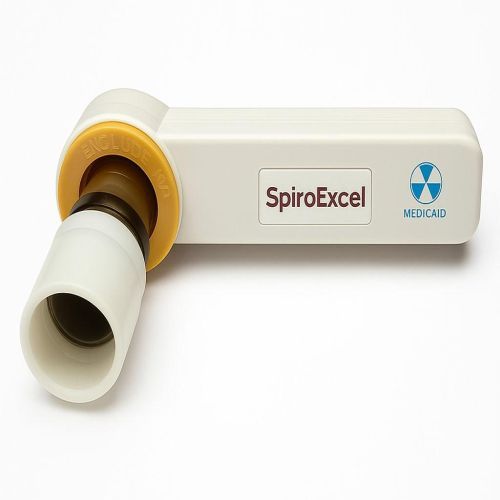
Software such as SPIROEXCELL includes encouragement screens and quality prompts.
Step 2: Look at FEV1/FVC
- Reduced ratio → obstruction (asthma, COPD, bronchiectasis).
- Interpret against the lower limit of normal (LLN) for age, sex and height. GOLD uses a fixed post-bronchodilator ratio below 0.70 to diagnose COPD.
Step 3: Look at FVC
- Reduced FVC with normal or high ratio → possible restriction (interstitial lung disease, chest wall or neuromuscular disease, obesity). Confirm with lung volumes.
- Both ratio and FVC reduced → mixed pattern or air trapping.
Step 4: Grade severity
Use FEV1 % predicted or z-scores according to the guideline your lab follows.
Step 5: Bronchodilator response
Repeat after a bronchodilator. A significant improvement supports asthma. Current ERS/ATS interpretation guidance expresses the change relative to predicted values, while older practice used ≥12% and ≥200 mL in FEV1 or FVC.
Flow-volume loop clues
- Concave (scooped) expiratory limb: obstruction.
- Small, narrow loop with preserved shape: restriction.
- Flattened loops: possible upper-airway obstruction.
Prediction equations matter
Choosing appropriate reference equations is crucial. See prediction equations for Indian patients.
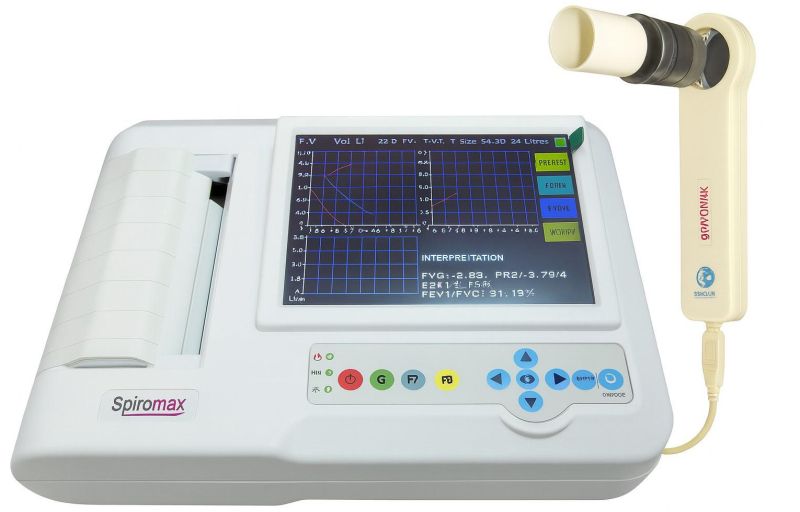
Need a spirometer with automatic interpretation? See the PFT range.
PFT Machine (PC-Based Spirometer)
USB PC-based spirometer with digital turbine and automatic interpretation. ₹35,000 – ₹50,000
Frequently Asked Questions
What is a normal FEV1/FVC?
It varies with age; many guidelines use the lower limit of normal, while GOLD uses a fixed ratio below 0.70 for COPD diagnosis.
Can spirometry diagnose restriction?
It can suggest it; lung volume measurement confirms it.
What makes a test unacceptable?
Poor start, cough, early termination, leaks or submaximal effort.
This article is for general information for healthcare buyers and professionals and is not medical advice. Clinical decisions should be made by qualified practitioners.